A structural shift in labor, migration, skills and productivity is changing Indian manufacturing.
Over the last several months, I have been hearing the same thing from manufacturing suppliers across India: “We cannot get enough labor.”
We hear it in Gujarat. We hear it in Maharashtra. We hear it in Tamil Nadu. These are not isolated factories. They include machining companies, foundries, casting suppliers, fabrication shops and other manufacturers.
Initially, it was easy to blame temporary disruptions. The Iran war and resulting gas and LPG shortages disrupted production. Factories reduced shifts. Migrant workers went home. Elections, festivals and seasonal migration added additional complications.
But energy supplies normalized—and many workers did not return. That made me wonder whether we are looking at something much bigger. I increasingly believe we are.
India does not have a shortage of people.
India has a growing shortage of reliable, mobile, factory-ready labor willing to work at the wages and under the conditions that much of Indian manufacturing was built around. That is a very different problem.
For decades, India’s manufacturing labor model was relatively straightforward. Workers migrated from Bihar, Uttar Pradesh, Odisha, Jharkhand, Madhya Pradesh and other lower-income regions to industrial centers such as Pune, Chakan, Rajkot, Ahmedabad, Sanand, Chennai, Hosur and Coimbatore.
A factory job paying ₹12,000–18,000 per month could represent a significant economic improvement. But the worker’s calculation is changing.
Imagine a young worker earning ₹18,000 per month in an industrial city. Subtract rent, food, transportation and trips home. Add a long commute, six-day workweeks, fixed shifts, factory discipline and living hundreds of kilometers away from family. Now compare that with staying closer to home and combining agriculture, construction, logistics, local industrial work, government employment programs or gig work.
Suddenly the migration premium is not nearly as attractive. That doesn’t mean people don’t want to work. It means the economics of migration have changed.
Factories are competing against completely different jobs.
A factory owner may think his labor competitor is the factory down the street. The worker sees a much broader marketplace: warehouses, construction, infrastructure projects, delivery, transportation, retail, local manufacturing and gig work.
A young worker may even accept similar income for a job that provides greater flexibility and autonomy. Manufacturing therefore has to compete for labor rather than simply assume labor will arrive.
India’s manufacturing success is ironically making the problem worse.
Look at what is happening around Sanand, Dholera, Pune, Chennai, Sriperumbudur and Hosur. India is attracting tremendous manufacturing investment in electronics, EVs, automotive, semiconductors, batteries, renewable energy, electrical equipment and data centers.
That is great news for India. But every new factory needs people. A new factory doesn’t manufacture 5,000 trained workers when it opens. It recruits them.
Large manufacturers recruit from medium-sized manufacturers. Medium manufacturers recruit from smaller companies. SMEs recruit from each other. A skilled CNC operator, maintenance technician, quality inspector or toolmaker can suddenly have several employers competing for him.
This is particularly painful for SMEs. A 100-person machining company cannot always match the transportation, canteen, housing, benefits, working environment and HR systems of a large multinational. So the SME trains someone—and six months later loses him.
Then management says: “There is a labor shortage.” Sometimes there is. But sometimes the uncomfortable truth is: there is a shortage of workers willing to work there at that compensation and under those conditions. Those are two very different diagnoses.
Housing and transportation have quietly become manufacturing infrastructure.
We talk constantly about industrial parks, highways, electricity and ports. We talk much less about where factory workers actually live.
If an operator spends two hours getting to work and two hours getting home, his ₹20,000 monthly wage looks very different. Worker housing, reliable transportation, food and quality of life are increasingly part of industrial competitiveness.
The factory gate can no longer be where management’s responsibility for labor availability begins and ends.
Then there is the skilled-labor problem.
This may ultimately be even more serious. Finding someone to move boxes is one challenge. Finding experienced CNC setters, toolmakers, welders, maintenance technicians, die-casting technicians, quality technicians, robot programmers and electricians is another.
India can simultaneously have millions of people seeking employment and factories unable to find qualified technicians. That is not a contradiction. It is a skills and location mismatch.
Which brings me to automation.
Indian manufacturing has traditionally had a perfectly rational reason not to automate: labor was inexpensive. But I think we need to revisit that calculation.
Too often, an SME owner looks at an automation proposal costing ₹8–10 lakh and says: “Why would I spend that? My operator costs only ₹20,000 per month.” But ₹20,000 is not the correct number.
Consider an operation requiring two workers per shift across two shifts. That is four positions. Now add wages, benefits, overtime, recruitment, labor contractor costs, training, absenteeism, attrition, supervision, quality variation and production losses when workers don’t show up.
Suddenly an ₹8–10 lakh automation investment looks very different.
And automation doesn’t necessarily mean buying an expensive ABB, FANUC or KUKA robot. India has an increasingly interesting ecosystem of domestic automation companies building Cartesian robots, gantry loaders, cobots, pick-and-place systems, vision inspection, conveyors, servo systems, special-purpose machines and pneumatic automation.
Sometimes the right answer isn’t a six-axis robot. It is simply good mechanical engineering. A ₹5–10 lakh solution that reliably removes one repetitive operation can be transformational for a small manufacturer.
China understood something important.
Chinese manufacturing wages are significantly higher than India’s. Yet China automates aggressively. Why? Because many Chinese manufacturers think about cost per piece. Indian SMEs too often still think about cost per worker.
Those are fundamentally different ways of looking at productivity.
India’s competitive advantage cannot permanently be: “Our people are cheaper.” It needs to become: “Our manufacturing system is more productive.”
This requires a change in how buyers evaluate suppliers too.
We are beginning to think differently about supplier capacity. Traditionally we ask: How many machines do you have? What is your monthly capacity? What is your utilization? What is your lead time?
Perhaps we should also ask: What percentage of required labor is currently staffed? What is monthly attrition? What is absenteeism? How many critical jobs are cross-trained? How dependent are you on migrant labor? What repetitive operations have you automated? What is your output per direct labor hour? What is your labor continuity plan?
Because a supplier with 30 CNC machines and labor to reliably operate only 20 of them does not really have 30 machines of capacity.
I don’t think India’s labor problem is temporary.
There will always be cycles. Workers will return after festivals. Labor markets will loosen during slower economic periods. Migration patterns will change.
But the structural forces are difficult to ignore: rising aspirations, more education, alternative employment, industrial expansion, infrastructure construction, urban housing costs, poor commuting conditions, skill shortages and competition for trained workers.
These trends are unlikely to reverse.
So perhaps the question Indian manufacturers should stop asking is: “When will labor come back?”
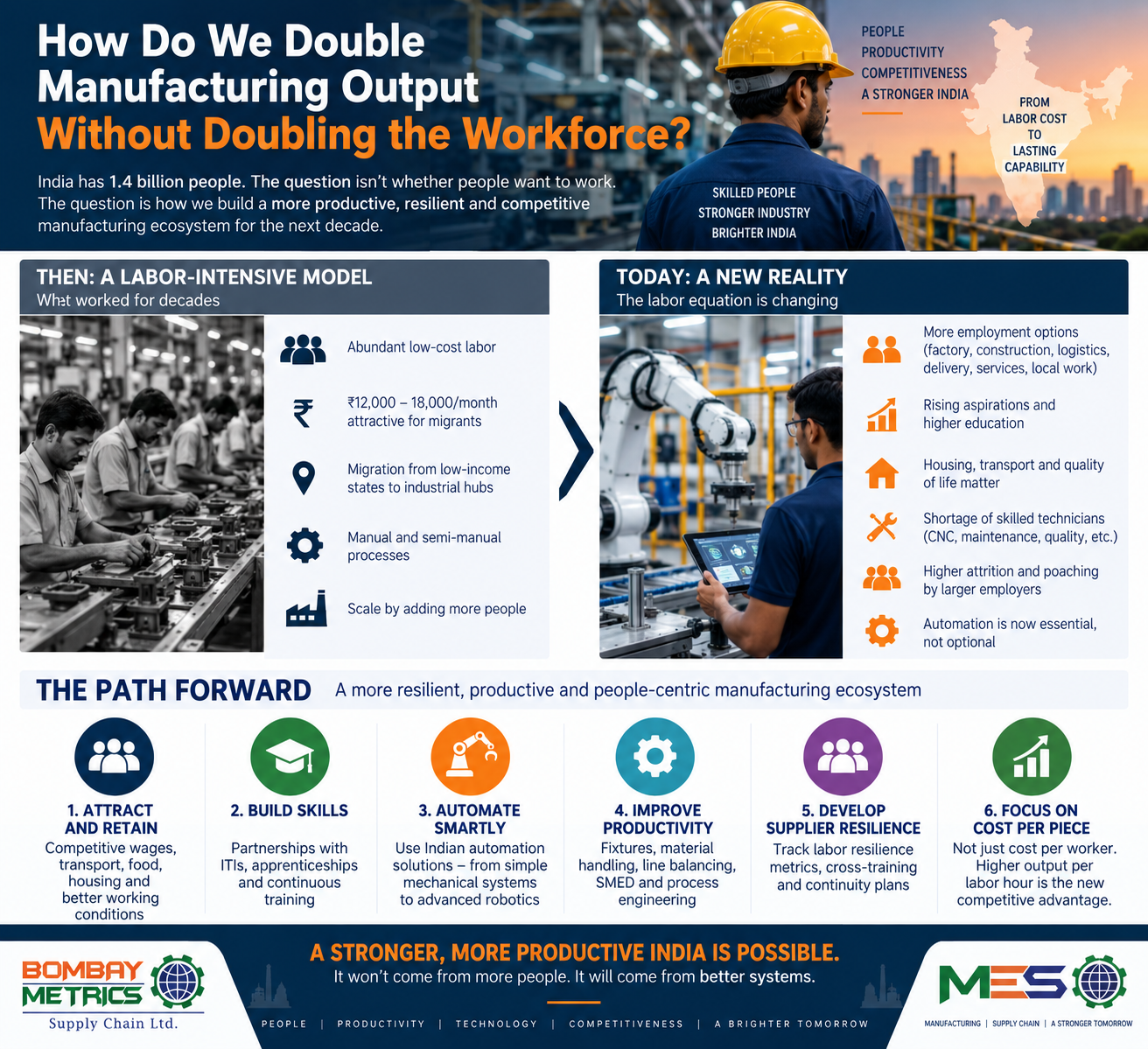
And start asking: “How do we double our business without doubling our workforce?”
That question leads to much more interesting answers: better training, better working conditions, worker transportation and housing, cross-training, process engineering, fixtures, material handling, automation, robotics and, most importantly, productivity.
The recent labor disruptions may eventually prove useful if they force Indian manufacturing to confront something that cheap and abundant labor allowed us to postpone for many years.
India’s next manufacturing advantage cannot simply be lower wages. It must be higher productivity per worker.
By: Hiten Shah – President – MES, Director – Bombay Metrics
MES is actively reviewing automation options to be deployed on a shared-cost-investment basis with key suppliers. Reach out to hshah@mesinc.net if you have solutions for automation with proven expertise for CNC machining, High Pressure Die Casting work, Iron casting secondary processes and Forgings.
HOW DO WE DOUBLE MANUFACTURING OUTPUT WITHOUT DOUBLING THE WORKFORCE?