
March 16, 2026

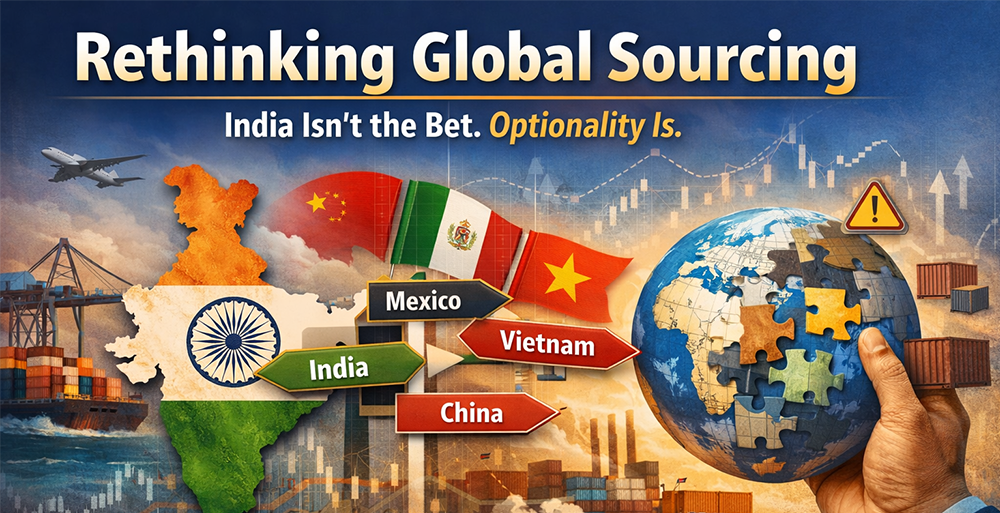
Over the past few years, India has become a central pillar in global sourcing conversations. For many organizations, it has been framed as the next big answer — a hedge against China, a beneficiary of shifting geopolitics, or a country poised to unlock cost advantages once trade agreements fall into place.
But this framing misses a more important truth.
India itself was never the bet. Optionality was.
Too often, sourcing strategies become country strategies. Organizations decide they are ‘moving to India’ or ‘shifting out of China’ and then attempt to align suppliers, volumes, and internal expectations around that single decision.
This approach assumes stability — in policy, costs, infrastructure, and execution. But global trade has entered a period where volatility is the rule, not the exception.
This has never been more true than last year. As Mark Carney noted in Davos this week “We are in the midst of a rupture, not a transition”. Rules based international order which existed since World War II and future policies look unpredictable at best and violent at its worst.
Trade agreements stall. Tariffs change. Sanctions emerge. Logistics routes are disrupted. Basing sourcing decisions on any single expected outcome introduces unnecessary risk.
The most resilient sourcing organizations are not betting on one country to outperform all others. They are building sourcing portfolios that can flex as conditions change.
In this context, India plays a critical role — but not in isolation.
We increasingly see high-performing organizations pairing India with:
• Mexico for speed, proximity, and tariff certainty
• Vietnam for labor-intensive manufacturing
• China for complex ecosystems and scale where required
India’s value often lies in engineering depth, supplier diversity, and long-term capability development — not blanket volume transfers.
Trade deals are episodic. They move in cycles and are subject to political timing beyond the control of sourcing teams.
Optionality, on the other hand, is structural. It is embedded in how suppliers are qualified, how tooling is structured, how contracts are written, and how volumes are allocated.
Organizations that wait for policy clarity before acting often find themselves late — paying higher prices, facing capacity constraints, or scrambling to qualify suppliers under pressure.
Optionality does not mean indecision. It means designing sourcing programs that work across multiple scenarios.
In practice, this includes:
• Qualifying suppliers in parallel across regions
• Structuring tooling and IP to remain portable
• Phasing volume commitments rather than making irreversible bets
• Separating capability sourcing from volume sourcing
• Maintaining commercial and logistical flexibility
These design choices allow organizations to move with confidence — even when policy outcomes remain uncertain.
The most important question is no longer:
“Will India get a trade deal?”
It is:
“Have we built enough optionality into our sourcing model to succeed regardless of the outcome?”
India remains an important part of global sourcing strategies. But the organizations that succeed are not betting on India alone.
They are betting on flexibility, resilience, and thoughtful design.
India isn’t the bet.
Optionality is.

