
March 16, 2026

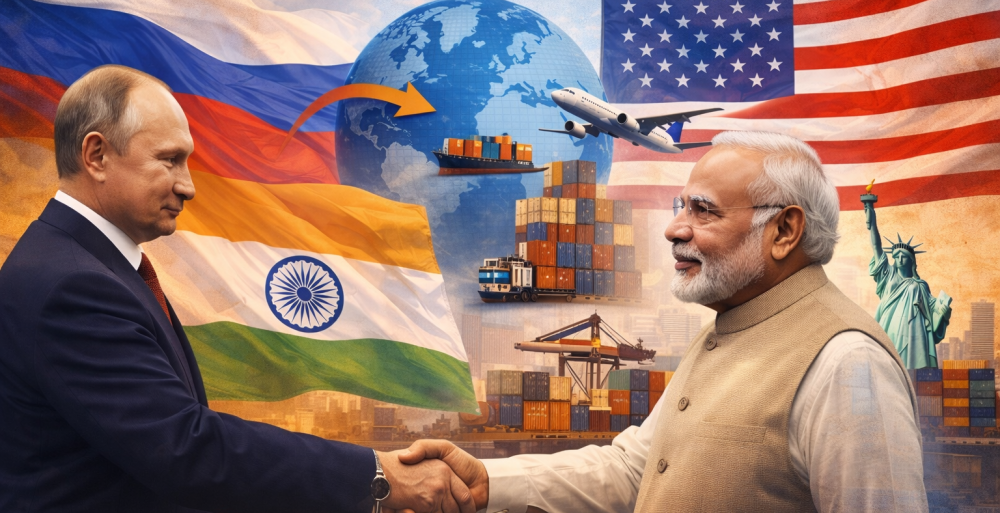
Russian President Vladimir Putin is visiting India this week. There are lots of sensitive issues at hand to be discussed as he meets Prime Minister Modi and his cabinet.
Putin’s Concerns:
India has reduced its oil purchase from Russia under US pressure and sanctions. India is also being pressured by US to buy defense systems for interoperability and joint military exercises.
What does US want India to do: From Washington’s perspective, India is:
A] World’s largest arms importer over last two decades. It accounted for 10% of global arms imports but still has 60% of its inventory of Soviet/Russian origin.
B] Shift procurement away from Russia and towards the US and its allies
C] Continue building upon new deals – GE engines for Tejas, MH-60R support, Javelin ATGMs, Excalibur artillery rounds instead of committing to new Russian S-500 and Su-57 jets
D] New 2025 defense framework signed last month with the US clearly shows Washington wants firm long-term pivot: interoperability, co-production, strategy alignment in the Indo-Pacific, and reduced dependence on Russian platforms
1] “Convergence Track”
This would include:
Impact:
2] The “Dual Track”
This would include:
Impact:
3] Russian Re-Deepening:
This would include:
Impact:
4] The Strategic Tilt
This would include:
Impact:
1 – Most likely scenario for the summit is that India commits to keeping legacy systems and upgrade them without upgrading commitment to new S-500 and Su-57 systems
2 – India will commit to keep buying Russian oil, exempted from sanction companies – keeping some share of their energy buys from Russia and maintaining autonomy and energy security
3 – India has been excellent at navigating US and other pressures – Modi has been adept at navigating the differences with patience, resolve and keeping their focus on Indian industries, agriculture, economy and autonomy.
4 – He is likely to pursue the “The Dual Track” scenario above. India continues US-India co-production, tech transfer, maritime security cooperation, ISR integration, and supply chain partnerships, while maintaining Russian platforms only through maintenance and controlled upgrades. India avoids major new Russian defense purchases that could trigger US political or sanctions pressure.
After this trip, we expect US-India trade deal to be a focus among administrators and cabinet. Most of the text has been agreed upon – Defense decision will allow two leaders – Modi and Trump to connect and finalize the agreement.

