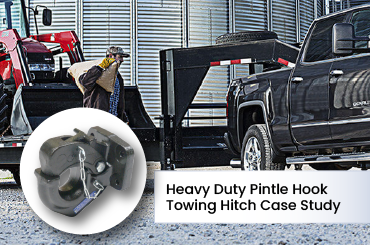
Heavy Duty Pintle Hook Towing Hitch Case Study

How we delivered everything to a German world leader in truck and commercial vehicle components wanted from its supplier.

Pintle Hook hitch is a seemingly simple application but it carries the load of the trailer or often the vehicles. It bears a lot of static and dynamic load as items being towed move around at high speeds on highways or at low speeds on an off-road terrain.

A German leader in trucking components was struggling with supply as well as cost for these pintle hooks from a domestic manufacturer in its own country. They had been looking for an option for a couple of years – an offshore manufacturer with high-quality capabilities but one which can take responsibility for warranty, product liability and provide Just-In-Time inventory.

The product would be tested rigorously via a variety of mechanical tests in the lab as well as a 100% track test. The product also had exacting tolerances as well as porosity specifications.

The product is an assembly of precision machined parts, Grey iron cast parts with low porosity as well an off-the-shelf fastener.

The manufacturer decided to work with MES’s European office for design review, design-for-manufacturing as well as commercial exercises and technical reviews. The process took several months including a grueling supplier audit of MES / Euro Metrics’s important offshore supplier. The supplier also needed IATF as well as ISO14000 certification.

——————————————————

We don’t shy away from demanding customers or high expectations at MES. Not only do we thrive on these things, but we also hold ourselves to the highest possible standards – especially when it comes to safety, production, and service.

Our standards are lofty, yet simple: produce excellently and deliver exceptionally.

So, we were unphased (and, quite frankly, thrilled) when a top-ranked, German-based producer of commercial vehicle components approached us with what many would call a demanding task and a significant ask.

The Challenge

For this manufacturing leader, producing trusted, competitively-priced products for a worldwide customer base would mean engaging the right supplier. The right supplier would be highly experienced in manufacturing commercial parts, equipped to produce incomparable parts to exacting standards, and provide reasonable cost savings.

Finding the right supplier also meant finding a world-class team that could produce 6 variations on 1 part using the sand-casting process. And, because all 6 parts are crucial to commercial truck-to-trailer connection, safety considerations must be paramount.

MES Insights

Our approach to any and every project involves a fair amount of “think time.” Never ones to be order takers, we engage a select team of experts, including Six Sigma engineers, quality inspectors, and supply chain professionals, to think not just about what we’re producing, but how we can do it with more efficiency, effectiveness, and stability.

We conducted a discovery phase, taking a deep dive into our customer’s specifications. Not only did we review and collaborate with our customers on these critical specifications for the final tooling design, but we also conducted a thorough tooling kickoff before production began.

In order to ensure that we achieved the precision needed within the tolerances allowed to ensure the safety and reliability for 6 variations of iron parts, we developed a specific quality checkpoint methodology. These quality checkpoints would continuously support both quality assurance and quality control throughout the manufacturing process

In addition, our quality engineers conducted in-person reviews of the raw materials and employed our industry-leading quality management system for precision measuring and inspection.

The Solution

At the core of our safety-focused solution for providing the highest quality, most reliable parts were these 4 essential tests, each of which was performed no less than 4 times per casting batch.

First-Pass Yield (FPY) Test – This procedure measures units that, when tested, pass on the first attempt before being checked in for repair. With FPY, if a unit fails enough times to enter repair, it is considered a failure. Typically, FPY is calculated for each process step.
Hardness Test – This test helps determine the suitability of a material for a given application. It also ensures that the material can conform to a specification, standard, or particular condition, such as a heat treatment or thermal process when subjected to it.
Tensile Test – This is a simple and widely used mechanical test that determines material properties and measures the force required to elongate a specimen to the breakpoint. Designers and quality managers use tensile testing to predict how a material or product will behave within its intended application.
Crack Test – This test helps detect defects in nonporous materials or surfaces, including ceramics, plastics, iron, and other metals. To ensure fault-free repair, it is essential to detect even the most minuscule out-of-spec crack.

The Results

Six versions of sand-casted iron, heavy-duty towing hitches rolled off our production lines with such accuracy and precision that they satisfied our customer’s safety demands and exceeded their expectations. To date, MES has produced thousands of hook trailer hitches with safety locks and continues to deliver on the most important imperative – safety.

Services:

Affordable Iron Sand Casting
Value-Added Engineering
Best-in-Class Quality Management
Competitive Pricing
Fast Tooling Lead Times

Find out how we can put these and other services to work for you. Contact Us today.
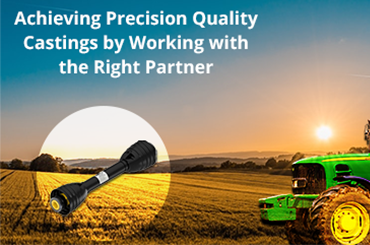
Developing Precision Machined Castings for Drivetrain Application

Developing Precision Machined Castings for Drivetrain Application

CUSTOMER SUCCESS STORY

When you’re a world leader in driveline systems and components, you expect world-class performance from your suppliers. So, when there’s a supplier quality issue and you’ve already employed reasonable and customary tactics to resolve it (to no avail), it’s time for drastic measures.

It’s time to find a new partner.

Here’s how MES stepped in to become this manufacturer’s reliable, go-to resource and exceed customer expectations and guarantee quality satisfaction.

Challenge: Lackluster Performance

 One of the benefits of investment casting is the quality. Complex geometries are the norm and intricate designs are to be expected. The finished product can be likened to a very nice golf club that looks exquisite, has a fine surface finish, and showcases a remarkable level of detail.

As such, investment casting typically lands on the higher side of the expense line. There’s certainly nothing wrong with that, but only if the quality of the castings is impeccable. Unfortunately, for this manufacturer of power transmission solutions, that wasn’t the case.

“From a quality standpoint, they were tired of their investment caster in China,” explains Joe Scopelite, Senior Sales Account Manager at MES. “They were using a process that should have been delivering much higher quality parts. Even with their best try, their dropout rate was 20%. Frankly, what they were getting was essentially junk. Then, when the company tried to migrate away, the supplier fell apart.”

But that wasn’t the only challenge. In addition to being too time-consuming and expensive to manage a lackluster overseas supplier, this manufacturer, which serves a variety of industries including construction and agriculture, found it too costly to handle the physical inventory themselves.

Insights: Find an Alternative

There’s more than one way to skin a cat, as they say. There’s also more than one way to cast parts. In working with our new customer, we recognized several things about their struggle, including:

  • The global business environment for import castings is extremely turbulent and only getting worse.
  • It was extremely difficult for them to find suppliers willing to guarantee quality while also developing a mutually beneficial business relationship.
  • It wasn’t feasible for them to have a local presence at the factory to collaborate and resolve quality or other manufacturing issues.
  • The primary issue was quality, not the type of casting.

This told us two things: (1) They would benefit from MES’s best-in-class supply chain solutions and value-added services; and (2) they were open to exploring an alternative casting option, as long as it met their exacting quality expectations.

And, if we were able to help them realize a cost savings, so much the better.

Solution: Global Reach

Our business model includes providing a strong support resource to deal with the supply chain pitfalls associated with global sourcing. So, the first thing we did was migrate our new customer away from their sub-par investment casting supplier and toward our quality-first sandcasting supplier.

Through our global network, we sourced a quality-committed supplier in India. By switching from investment casting to sandcasting, we’re delivering a higher quality part than the supplier in China and doing so even faster.

For this customer’s parts, there are critical geometric tolerances that can only be checked with a coordinate measuring machine or CMM. Although our foundry supplier does not have a CMM to perform the necessary checks, we’ve taken ownership and are checking these features with our own CMM so that we can ensure we’re satisfying the critical demand that the company’s engineering and quality control people expect (and rightly so).

MES also has conformed with our customer’s radiographic and magniflux tests to ensure that our supplier’s casting processes always deliver the required quality. In fact, because MES is so committed to ensuring quality, there’s isn’t a test criterion they’ve thrown at us that we haven’t embraced and incorporated into the pre-production part prove-out process.

As a result of this diligence and commitment, this solution is on track to yield a nearly $500,000 savings for our customer in the first year – and we’re not even in full production yet on a total of 33 parts.

We also have relieved them of their inventory woes by keeping and managing an inventory of their parts in our Ohio warehouse. By drawing from our parts cache rather than overseeing the supply chain pipeline themselves, our customer have saved countless amounts of time, money, and hassle.

Results: Approved and Appreciated

“MES has a strong, collaborative team that’s committed to addressing our customer’s needs,” says Joe. “Our customers has expressed their appreciation and approval for our team’s work in providing superior quality castings, on time, at competitive prices, while easing the burden of having to manage their day-to-day supply chain issues. MES has proven to be a great fit, yet we’re not stopping where we are.  MES continues to generate key new supply chain resources through innovative business ventures and service programs, offering our customer even more value.”

Ready to explore alternative solutions that may save you thousands? Contact MES to learn more.

Expertise

Developing Rapid Prototypes to Fast-Track Harbinger’s EV Production

The outlook for commercial electric vehicle (EV) companies is bright yet highly competitive. Nobody knows this better than MES. One of our EV customers, Harbinger Motors, is on a mission to transform an industry they say is “starving for innovation.” Its best-in-class team of in-house developed suspension, electrical, battery, and drivetrain experts has successfully developed proprietary technologies for medium-duty commercial vehicles by completing the Beta phase build and now entering Pilot production.

The Challenge: Accelerate a Beta Version Vehicle Build

Tight timelines literally drive the automotive industry, and none more so than the EV market. As the maker of the first-of-its-kind, vertically integrated EV platform for commercial fleets and medium-duty vehicles, this California-based company felt pressure to introduce its Beta Version Vehicle to the world on time and on budget, thus fulfilling its commitment to investors.

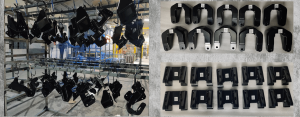
They had the vision, and they knew how to get to the finish line by partnering with global suppliers like MES. The only problem was that they needed die cast components and structural forgings even before development was completed as they transitioned from prototyped parts to production level tools. Specifically, they needed eight component variants in just two short weeks to cover production requirements before development completed and first production samples available

MES offered its use of industry-leading supplier base for prototyping as a solution. While rapid prototyping in and of itself is enough of a challenge, there were very specific requirements for their Pilot Vehicle builds:

  • Manufactured from 42CrMo4 Alloy Steel block (SAE 4140)
  • Machined per 3D model
  • Tolerances per 2D prints
  • CED coated with a top coat with powder coat finish
  • Must withstand 1,000 hours of salt spray life

The Solution: Technology Meets Technique

Rapid prototyping capabilities are essential for EV makers, giving them and other automotive manufacturers the ability to speed their product design and development to market ahead of the competition.

While the need for fast manufacturing is obvious, the “how to get there” is not.

”Our Bombay Metrics team excelled in offering timely solution to this gap in available parts that put customer production at-risk. It truly was remarkable how quickly we identified a supplier that could meet the demanding schedule,” says Austin Downs, “In fact, the customer had another solution for prototyping however they could not meet the timeline and pricing was much higher. Our team excelled at quality and delivery whistling juggling three suppliers to produce the parts, without hiccup.” –  Raj Nanjukutty Bombay Metrics General Manager

Overcoming Rapid Prototyping Challenges

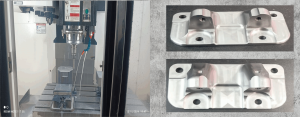
 12 Vertical Milling Centers (VMC) and two 5-Axis machines to meet specifications and deliver them to their facility just in time for the vehicle build.

We also CED coated all the parts to a specified thickness of 25 micron before powder coating them to a thickness of 80 micron. For these processes, critical areas were masked like bolt holes to ensure the highest quality surface finishing and final functionality.

Finally, we leveraged our quality processes, which included CMM inspection and scanning. These efforts resulted in a fast and successful project completion and an elated customer.

“I’m excited to share that the stop-gap procedure was a success, and we’ve now successfully launched mass production components using the hot steel forging process on 2500 mt screen press. As battery  mounting brackets for battery packs, the forging process was chosen for its exceptional strength—a critical requirement to ensure the heavy battery packs remain securely in place .” – Austin Downs, MES Sales Manager

The Result: Changing the EV Industry

 By delivering best-in-class rapid prototyping, MES was able speed the completion of initial Pilot builds, and further reinforce the company’s position as an innovation leader that is building the future of e-mobility. MES first partnered with Harbinger over a year ago, having helped them source a Friction Stir Welding (FSW) supplier in 2023.

Contact us to find out how MES can put rapid prototyping capabilities and manufacturing solutions like these to work for you:

  • Rapid prototyping: Aluminum, alloy steel, carbon steel, stainless steel, duplex/super duplex stainless steel, special alloys, copper-based alloys
  • Precision machining: Machined parts from blocks with linear and geometric tolerances from 5 micron (0.000196)
  • Advanced technologies: DMG Mori, Hass, Makino, Mazak VMCs and 5-Axis
  • Shorter lead times: 3 working days for first part delivery
  • Post-processing solutions: Gear cutting, heat treatments, plating, powder coating, welding