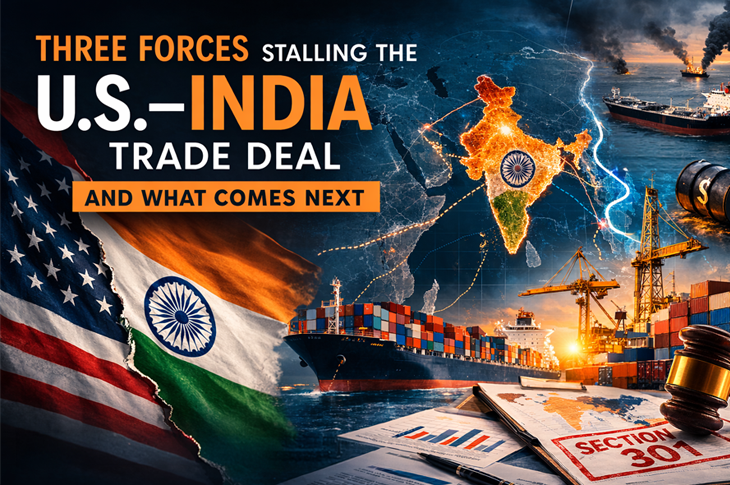
Three Forces Stalling the U.S.–India Trade Deal 

And What Comes Next 

A month ago, the U.S.–India interim trade deal appeared to be within reach. Both sides had aligned on the broad framework — India would curb Russian oil imports, lower duties on American goods, and commit to $500 billion in bilateral trade by 2030. Washington, in turn, would reduce punitive tariffs on Indian exports. Commerce Secretary Rajesh Agrawal had penciled in mid-March as a signing window. 

That timeline is now off the table. 

Three separate forces — a landmark U.S. Supreme Court ruling, an escalating conflict with Iran, and Washington’s latest tariff offensive — have created a more complicated landscape. Here is what happened, and where this is most likely heading.


  1. The Supreme Court Reset

On February 20, 2026, the U.S. Supreme Court ruled 6–3 that President Trump’s sweeping ‘reciprocal tariffs’ — imposed under the International Emergency Economic Powers Act (IEEPA) — exceeded the authority Congress had delegated to the executive branch. The ruling did not end tariffs. But it removed the administration’s fastest and broadest tool for creating urgency at the negotiating table. 

Within 24 hours, Washington pivoted to a 10% universal tariff under Section 122 of U.S. trade law — a mechanism that carries its own constraint: it expires after roughly 150 days without congressional approval. The threat structure that originally pushed both sides toward a deal has fundamentally changed. 

For India, this changed the calculus entirely. India’s Commerce Minister Piyush Goyal was direct — his country would resume talks only when there is ‘more clarity.’ Sources in New Delhi were blunter: ‘We are not in a hurry to sign any deal.’ New Delhi also has legitimate questions: under the original framework, India’s exports were to face an 18% duty rate. It is now unclear whether Washington will revert to that number or apply a different level. 

Our estimate: the interim deal is now likely 3 to 4 months away at the earliest, with a comprehensive Bilateral Trade Agreement more realistically a late 2026 or 2027 outcome. 


  1. Iran — The Geopolitical Wildcard

While trade negotiators paused, a larger crisis absorbed Washington’s attention. The U.S.-Israel conflict with Iran has closed the Strait of Hormuz to commercial shipping, sending Brent crude above $120 a barrel and disrupting energy flows across the region. 

For India, the exposure is significant. More than 60% of India’s oil and over 80% of its gas transit the Strait of Hormuz. Within days of the conflict escalating, domestic LPG prices rose ₹60 per cylinder, flight cancellations mounted, and airline capacity tightened across Gulf routes. Some 9.1 million Indian workers in Gulf Cooperation Council countries — who remit approximately $50 billion home annually — now face genuine income risk if the conflict prolongs. 

The Chabahar port corridor — India’s key trade route to Central Asia that bypasses Pakistan — faces indefinite delays. The U.S. waiver permitting Indian operations at Chabahar expires in April, and renewal is now uncertain. 

There is one near-term offset. The U.S. has granted India a 30-day waiver to continue buying Russian crude — an acknowledgment that with Gulf supply disrupted, Washington cannot simultaneously cut off India’s alternative source without triggering a deeper crisis. This is a pragmatic concession, not a strategic shift. The underlying pressure to reduce Russian oil dependency remains firmly on the table. 

For supply chain and sourcing professionals: the Iran conflict reinforces what we have been saying for the past year. Optionality in energy sourcing and logistics routes is not a planning luxury — it is a business continuity requirement. 


  1. Section 301 — Washington’s New Tariff Toolkit

On March 11–12, the Office of the U.S. Trade Representative launched a fresh round of Section 301 investigations targeting 16 economies: India, China, the EU, Japan, South Korea, Mexico, Singapore, Switzerland, Norway, Australia, Indonesia, Malaysia, Thailand, and others. The stated focus is ‘structural excess capacity and production in manufacturing sectors’ — broadly targeting industrial subsidies and state-directed production. 

This is a significant legal shift. Unlike the IEEPA tariffs struck down by the Court, Section 301 is congressionally grounded and legally durable. USTR Jamieson Greer signaled that the investigation could lead to new tariffs as early as this summer. 

India has read this clearly. New Delhi views the probe as a pressure tactic — a way to force trading partners into signing bilateral deals now that the IEEPA route has been closed. One government source called it ‘a spanner in the works.’ India plans to present its position to USTR and has signaled it may approach the WTO if the investigation proceeds unfairly. 

The practical implication for business: Section 301 investigations typically run up to 12 months, but outcomes can be accelerated under political pressure. Companies sourcing from India in industrial goods, chemicals, electronics, and manufacturing-adjacent sectors should begin scenario planning now — because the investigation’s conclusions will directly shape duty structures going into 2027. 


What to Expect: Timing and Probabilities 

Our current read on the most likely outcomes: 

Outcome Probability Estimated Timeline
U.S.–India interim deal signed – Tariffs reduced 55–65% June–August 2026
Full Bilateral Trade Agreement 40–50% Late 2026 – Early 2027
Section 301 tariffs imposed on India 30–40% June’ 2026
Deal delayed beyond 2026 20–25% 2027+


The biggest swing factor is Iran. If the conflict de-escalates within the next 60 days, Washington’s bandwidth returns to trade negotiations and both sides have reason to close the gap quickly. If the conflict prolongs through summer, the bilateral deal slips further — and the Section 301 investigation becomes the dominant pressure mechanism. India will not sign under duress. It has demonstrated, repeatedly, that it absorbs pressure without capitulating. 


Final Thought 

The U.S.–India trade deal is not dead. It is navigating a messier set of circumstances than anyone anticipated when the year began. For business leaders and sourcing teams, the lesson is a familiar one: do not structure your supply chain strategy around a single policy outcome. 

The organizations best positioned through this period are not waiting for a deal to be signed. They are qualifying suppliers in India now, building parallel options in Mexico and Vietnam, and structuring contracts that flex as tariff realities shift. The India–EU FTA, which is already in motion, provides a separate and more stable planning horizon for companies with EU-facing supply chains. 

We remain cautiously optimistic that a partial U.S.–India agreement gets done before year-end. But the path will be longer, and the conditions will be different from what was originally expected. Plan for that — not for the deal that was supposed to happen last month. 

The deal is coming. Just not on anyone’s original schedule. 
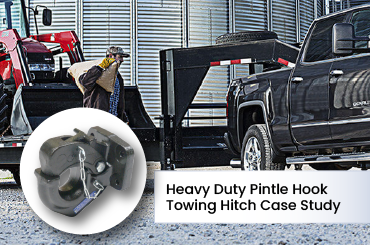
 

Heavy Duty Pintle Hook Towing Hitch Case Study

How we delivered everything to a German world leader in truck and commercial vehicle components wanted from its supplier.

Pintle Hook hitch is a seemingly simple application but it carries the load of the trailer or often the vehicles. It bears a lot of static and dynamic load as items being towed move around at high speeds on highways or at low speeds on an off-road terrain.

A German leader in trucking components was struggling with supply as well as cost for these pintle hooks from a domestic manufacturer in its own country. They had been looking for an option for a couple of years – an offshore manufacturer with high-quality capabilities but one which can take responsibility for warranty, product liability and provide Just-In-Time inventory.

The product would be tested rigorously via a variety of mechanical tests in the lab as well as a 100% track test. The product also had exacting tolerances as well as porosity specifications.

The product is an assembly of precision machined parts, Grey iron cast parts with low porosity as well an off-the-shelf fastener.

The manufacturer decided to work with MES’s European office for design review, design-for-manufacturing as well as commercial exercises and technical reviews. The process took several months including a grueling supplier audit of MES / Euro Metrics’s important offshore supplier. The supplier also needed IATF as well as ISO14000 certification.

——————————————————

We don’t shy away from demanding customers or high expectations at MES. Not only do we thrive on these things, but we also hold ourselves to the highest possible standards – especially when it comes to safety, production, and service.

Our standards are lofty, yet simple: produce excellently and deliver exceptionally.

So, we were unphased (and, quite frankly, thrilled) when a top-ranked, German-based producer of commercial vehicle components approached us with what many would call a demanding task and a significant ask.

The Challenge

For this manufacturing leader, producing trusted, competitively-priced products for a worldwide customer base would mean engaging the right supplier. The right supplier would be highly experienced in manufacturing commercial parts, equipped to produce incomparable parts to exacting standards, and provide reasonable cost savings.

Finding the right supplier also meant finding a world-class team that could produce 6 variations on 1 part using the sand-casting process. And, because all 6 parts are crucial to commercial truck-to-trailer connection, safety considerations must be paramount.

MES Insights

Our approach to any and every project involves a fair amount of “think time.” Never ones to be order takers, we engage a select team of experts, including Six Sigma engineers, quality inspectors, and supply chain professionals, to think not just about what we’re producing, but how we can do it with more efficiency, effectiveness, and stability.

We conducted a discovery phase, taking a deep dive into our customer’s specifications. Not only did we review and collaborate with our customers on these critical specifications for the final tooling design, but we also conducted a thorough tooling kickoff before production began.

In order to ensure that we achieved the precision needed within the tolerances allowed to ensure the safety and reliability for 6 variations of iron parts, we developed a specific quality checkpoint methodology. These quality checkpoints would continuously support both quality assurance and quality control throughout the manufacturing process

In addition, our quality engineers conducted in-person reviews of the raw materials and employed our industry-leading quality management system for precision measuring and inspection.

The Solution

At the core of our safety-focused solution for providing the highest quality, most reliable parts were these 4 essential tests, each of which was performed no less than 4 times per casting batch.

First-Pass Yield (FPY) Test – This procedure measures units that, when tested, pass on the first attempt before being checked in for repair. With FPY, if a unit fails enough times to enter repair, it is considered a failure. Typically, FPY is calculated for each process step.
Hardness Test – This test helps determine the suitability of a material for a given application. It also ensures that the material can conform to a specification, standard, or particular condition, such as a heat treatment or thermal process when subjected to it.
Tensile Test – This is a simple and widely used mechanical test that determines material properties and measures the force required to elongate a specimen to the breakpoint. Designers and quality managers use tensile testing to predict how a material or product will behave within its intended application.
Crack Test – This test helps detect defects in nonporous materials or surfaces, including ceramics, plastics, iron, and other metals. To ensure fault-free repair, it is essential to detect even the most minuscule out-of-spec crack.

The Results

Six versions of sand-casted iron, heavy-duty towing hitches rolled off our production lines with such accuracy and precision that they satisfied our customer’s safety demands and exceeded their expectations. To date, MES has produced thousands of hook trailer hitches with safety locks and continues to deliver on the most important imperative – safety.

Services:

Affordable Iron Sand Casting
Value-Added Engineering
Best-in-Class Quality Management
Competitive Pricing
Fast Tooling Lead Times

Find out how we can put these and other services to work for you. Contact Us today.

Developing Precision Machined Castings for Drivetrain Application

Developing Precision Machined Castings for Drivetrain Application

CUSTOMER SUCCESS STORY

When you’re a world leader in driveline systems and components, you expect world-class performance from your suppliers. So, when there’s a supplier quality issue and you’ve already employed reasonable and customary tactics to resolve it (to no avail), it’s time for drastic measures.

It’s time to find a new partner.

Here’s how MES stepped in to become this manufacturer’s reliable, go-to resource and exceed customer expectations and guarantee quality satisfaction.

Challenge: Lackluster Performance

 One of the benefits of investment casting is the quality. Complex geometries are the norm and intricate designs are to be expected. The finished product can be likened to a very nice golf club that looks exquisite, has a fine surface finish, and showcases a remarkable level of detail.

As such, investment casting typically lands on the higher side of the expense line. There’s certainly nothing wrong with that, but only if the quality of the castings is impeccable. Unfortunately, for this manufacturer of power transmission solutions, that wasn’t the case.

“From a quality standpoint, they were tired of their investment caster in China,” explains Joe Scopelite, Senior Sales Account Manager at MES. “They were using a process that should have been delivering much higher quality parts. Even with their best try, their dropout rate was 20%. Frankly, what they were getting was essentially junk. Then, when the company tried to migrate away, the supplier fell apart.”

But that wasn’t the only challenge. In addition to being too time-consuming and expensive to manage a lackluster overseas supplier, this manufacturer, which serves a variety of industries including construction and agriculture, found it too costly to handle the physical inventory themselves.

Insights: Find an Alternative

There’s more than one way to skin a cat, as they say. There’s also more than one way to cast parts. In working with our new customer, we recognized several things about their struggle, including:

  • The global business environment for import castings is extremely turbulent and only getting worse.
  • It was extremely difficult for them to find suppliers willing to guarantee quality while also developing a mutually beneficial business relationship.
  • It wasn’t feasible for them to have a local presence at the factory to collaborate and resolve quality or other manufacturing issues.
  • The primary issue was quality, not the type of casting.

This told us two things: (1) They would benefit from MES’s best-in-class supply chain solutions and value-added services; and (2) they were open to exploring an alternative casting option, as long as it met their exacting quality expectations.

And, if we were able to help them realize a cost savings, so much the better.

Solution: Global Reach

Our business model includes providing a strong support resource to deal with the supply chain pitfalls associated with global sourcing. So, the first thing we did was migrate our new customer away from their sub-par investment casting supplier and toward our quality-first sandcasting supplier.

Through our global network, we sourced a quality-committed supplier in India. By switching from investment casting to sandcasting, we’re delivering a higher quality part than the supplier in China and doing so even faster.

For this customer’s parts, there are critical geometric tolerances that can only be checked with a coordinate measuring machine or CMM. Although our foundry supplier does not have a CMM to perform the necessary checks, we’ve taken ownership and are checking these features with our own CMM so that we can ensure we’re satisfying the critical demand that the company’s engineering and quality control people expect (and rightly so).

MES also has conformed with our customer’s radiographic and magniflux tests to ensure that our supplier’s casting processes always deliver the required quality. In fact, because MES is so committed to ensuring quality, there’s isn’t a test criterion they’ve thrown at us that we haven’t embraced and incorporated into the pre-production part prove-out process.

As a result of this diligence and commitment, this solution is on track to yield a nearly $500,000 savings for our customer in the first year – and we’re not even in full production yet on a total of 33 parts.

We also have relieved them of their inventory woes by keeping and managing an inventory of their parts in our Ohio warehouse. By drawing from our parts cache rather than overseeing the supply chain pipeline themselves, our customer have saved countless amounts of time, money, and hassle.

Results: Approved and Appreciated

“MES has a strong, collaborative team that’s committed to addressing our customer’s needs,” says Joe. “Our customers has expressed their appreciation and approval for our team’s work in providing superior quality castings, on time, at competitive prices, while easing the burden of having to manage their day-to-day supply chain issues. MES has proven to be a great fit, yet we’re not stopping where we are.  MES continues to generate key new supply chain resources through innovative business ventures and service programs, offering our customer even more value.”

Ready to explore alternative solutions that may save you thousands? Contact MES to learn more.

Expertise