India–EU Free Trade Agreement: The Mother of All Deals Why the Timeline Matters More Than the Headline


The signing of the India–European Union Free Trade Agreement marks a historic moment in global trade. It is India’s largest trade deal by economic scale and one of the most comprehensive agreements, the EU has signed with a developing economy. 

But beyond the headline numbers, the real impact of this agreement lies in how tariffs are reduced — not simply that they are reduced. 

For business leaders, sourcing heads, and supply-chain executives, this agreement is less about politics and more about timelines, sequencing, and strategic positioning. 

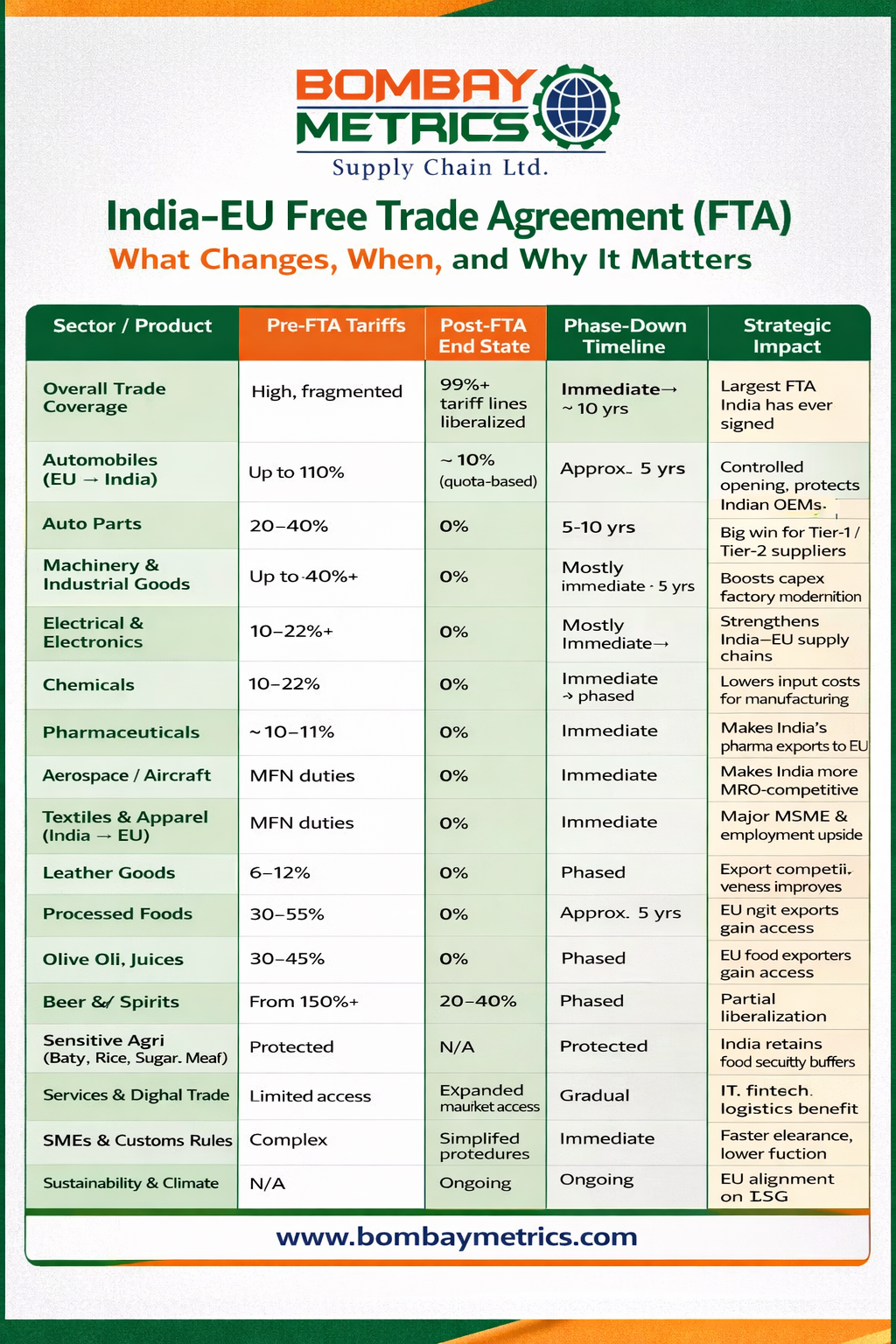
Unlike older FTAs that attempted abrupt tariff elimination, the India–EU FTA is deliberately structured around gradual liberalization. Over 99% of tariff lines will eventually be liberalized, but the journey spans immediate cuts, five-year ramps, and ten-year glide paths. Sensitive sectors remain protected to preserve domestic stability. 

Industrial manufacturing, machinery, electrical equipment, chemicals, and capital goods see some of the fastest tariff elimination. Many tariff lines drop to zero either at entry into force or within a few years, directly improving India’s manufacturing competitiveness. 

Textiles, apparel, and leather exports from India into the EU move rapidly to zero-duty access. This is a structural win for labor-intensive manufacturing, MSMEs, and India’s China-plus-one sourcing narrative. 

Chemicals, pharmaceuticals, and aerospace products also see early liberalization. This strengthens India’s position in global pharma supply chains, aerospace MRO, and specialty manufacturing. 

Where liberalization is slower is equally important. Automobiles follow a controlled, quota-based reduction path, protecting domestic OEMs while allowing gradual integration with European supply chains. 

Sensitive agricultural sectors such as dairy, rice, sugar, and meat remain largely protected, signaling that trade liberalization will not override food security or rural stability. 

From a supply-chain strategy perspective, this agreement should be viewed as a planning framework rather than a short-term event. Phased tariff reductions allow companies to re-sequence sourcing decisions, plan capex, shift product mixes, and align supplier development with tariff milestones. 

The real winners will not be the companies that react first, but those that plan best. In a world of increasing tariff volatility and geopolitical fragmentation, the India–EU FTA restores predictability, structure, and long-term visibility for global trade. 

This is not a day-one win agreement. It is a decade-long advantage for companies that understand the timeline and act accordingly. 

Here is the summary of all the items affected by the trade deal and how they gradually come into effect
Putin Visit and Impact on US trade deal


Russian President Vladimir Putin is visiting India this week. There are lots of sensitive issues at hand to be discussed as he meets Prime Minister Modi and his cabinet. 

Putin’s Concerns: 

India has reduced its oil purchase from Russia under US pressure and sanctions. India is also being pressured by US to buy defense systems for interoperability and joint military exercises.   

What does US want India to do: From Washington’s perspective, India is:  

A] World’s largest arms importer over last two decades. It accounted for 10% of global arms imports but still has 60% of its inventory of Soviet/Russian origin.  

B] Shift procurement away from Russia and towards the US and its allies  

C] Continue building upon new deals – GE engines for Tejas, MH-60R support, Javelin ATGMs, Excalibur artillery rounds instead of committing to new Russian S-500 and Su-57 jets  

D] New 2025 defense framework signed last month with the US clearly shows Washington wants firm long-term pivot: interoperability, co-production, strategy alignment in the Indo-Pacific, and reduced dependence on Russian platforms  

India-US defense relationship: Four Scenarios 

1] “Convergence Track”  

This would include: 

  • India deepens the 10-year India-US defense framework signed in 2025.  
  • Co-Production of jet engines, drones, air-launched munitions, and maritime ISR systems accelerates under INDUS-X. 
  • India avoids new major Russian purchases such as S-500 and Su-57 
  • India’s procurement spends gradually shift: Russia, France & US 

Impact: 

  • US pushes components and assemblies into India – India becomes a regional defense-supply hub. 

2] The “Dual Track” 

This would include: 

  • India signs limited new Russian deals but keeps them compartmentalized 
  • India also expanse US ties – more maritime systems, drones, artillery precision rounds, and sustainment agreements. 

Impact: 

  • Growth continues but below potential 
  • Co-production moves ahead but without Advanced critical technologies  

3] Russian Re-Deepening: 

This would include: 

  • India signs two major deals with Russia 
  • US Congress reinstates pressure on India 

Impact: 

  • US-India supply-chain cooperation slows and India focuses on domestic R&D 


4] The Strategic Tilt 

This would include: 

  • A major regional crisis forces India to prioritize full interoperability with the US, Japan and Australia 
  • India freezes new Russian contracts beyond maintenance 

Impact: 

  • Massive expansion of US-India co-development and co-manufacturing 
  • India becomes a major export-production base for US-origin systems in the Indian Ocean region 


Putin Visit and What to Watch. 

1 – Most likely scenario for the summit is that India commits to keeping legacy systems and upgrade them without upgrading commitment to new S-500 and Su-57 systems 


2 – India will commit to keep buying Russian oil, exempted from sanction companies – keeping some share of their energy buys from Russia and maintaining autonomy and energy security 


3 – India has been excellent at navigating US and other pressures – Modi has been adept at navigating the differences with patience, resolve and keeping their focus on Indian industries, agriculture, economy and autonomy.  


4 – He is likely to pursue the “The Dual Track” scenario above. India continues US-India co-production, tech transfer, maritime security cooperation, ISR integration, and supply chain partnerships, while maintaining Russian platforms only through maintenance and controlled upgrades. India avoids major new Russian defense purchases that could trigger US political or sanctions pressure. 


After this trip, we expect US-India trade deal to be a focus among administrators and cabinet. Most of the text has been agreed upon – Defense decision will allow two leaders – Modi and Trump to connect and finalize the agreement.  


Supreme Court Tariff Ruling & Impact on Metal Industry

 The U.S. Supreme Court is reviewing whether the International Emergency Economic Powers Act (IEEPA) can legally serve as a basis for broad, economy‑wide import tariffs. A ruling is expected in late 2025 or early 2026. While the case focuses on legal authority rather than specific products, the decision could influence how future tariff programs are implemented, including those affecting industrial metal supply chains.

Many metal-intensive products fall under tariff lines frequently involved in U.S. trade actions:
• Cast Iron & Steel Articles – HTS 7325, 7326
• Steel and Alloy Forgings – HTS 7208–7229
• Non-Ferrous Forgings – HTS 7419 (copper), 7606–7616 (aluminum), 7907 (zinc), 8007 (tin), 8108 (titanium)
• Machined Components – HTS 7326.90, 7616.99, 8708.x
• Semi‑Finished Inputs – HTS 7208–7229 (steel), 7403–7409 (copper), 7604–7607 (aluminum) 

In general, most of the HTS codes above (For China) are subjected to: 

2018 – Section 301 Tariffs – 25% 

2025 – IEEPA Tariffs – 20% 

2025 – Reciprocal Tariffs – 10% 

If Court ruling changes and indication from judges questioning is that they were skeptical about IEEPA application at large, 20% will be reduced or eliminated.  

If the Court limits or reverses IEEPA authority:
1. Certain tariff programs may be paused, restructured, or reassessed under other statutes.
2. Metal importers could see potential refund reviews for tariffs imposed under IEEPA.
3. Tariffs may shift toward Section 301, 232, or 201, changing rates and product coverage.
4. Contract pricing for castings, forgings, and machined components may require adjustment.
5. Sourcing strategies may shift as cost, tariff exposure, and lead times change.

This ruling will not target metals directly, but it will shape how tariff tools are used in the future. For customers, suppliers, and industry partners, staying informed and maintaining strong duty‑tracking and sourcing flexibility will be essential.