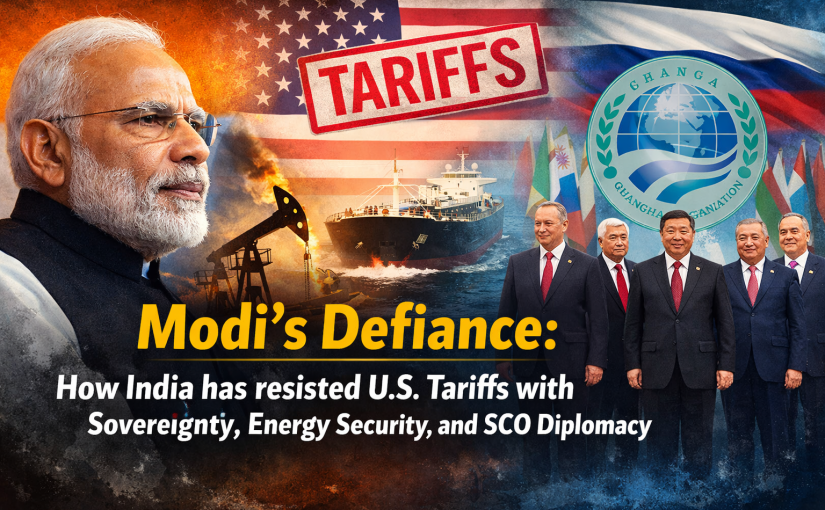
Modi’s Defiance: How India has resisted U.S. Tariffs with Sovereignty, Energy Security, and SCO Diplomacy

The U.S. decision to impose 25–50% tariffs on Indian exports in response to India’s continued purchases of Russian crude oil has triggered one of the sharpest trade disputes in recent years. While Washington framed the move as a way to cut off Moscow’s revenue streams, New Delhi saw it very differently: as an assault on its sovereignty and its right to make independent choices in a volatile global energy market. 

Prime Minister Narendra Modi’s response has been clear and consistent: India will not yield to foreign pressure. Instead, his government has used this moment to reinforce themes of self-reliance, national dignity, and energy security while strengthening alternative alliances. 


  1. Protecting Domestic Producers

From the very beginning, Modi positioned the tariffs as not just a policy dispute with Washington but a direct attack on the livelihoods of ordinary Indians. His speeches have highlighted how such measures hurt farmers, fisherfolk, artisans, and small manufacturers—the very backbone of India’s export economy. 42 – 46% of total employment in India is in agriculture sector. 

Rather than signaling retreat, Modi doubled down on calls for “Atmanirbhar Bharat” (self-reliant India)—urging greater reliance on Indian-made goods and discouraging dependence on imported products. The idea of boycotting foreign goods resonates strongly with his political base and reframes the tariff dispute as a battle for the dignity of Indian producers. 

This strategy also allows Modi to align external trade policy with his long-running domestic agenda of boosting local manufacturing and employment. 


  1. Sovereignty First: Rejecting Double Standards

India’s Ministry of External Affairs called the U.S. tariffs “unfair and unjustified,” pointing out that many Western countries themselves continue buying Russian resources—from uranium and fertilizers to liquefied natural gas. By highlighting these inconsistencies, India accused Washington and Brussels of “double standards.” 

For Modi, the message is simple: India’s foreign policy is not up for negotiation. Decisions on where to source energy or how to balance trade relationships will be made in Delhi—not in Washington. 

This emphasis on sovereignty and independent decision-making is more than rhetorical. It fits into a longer tradition of India’s “strategic autonomy,” a foreign policy principle that resists alignment with any single power bloc. Modi has made clear that India values its partnership with the U.S., but not at the cost of compromising its freedom to act in its own national interest. 
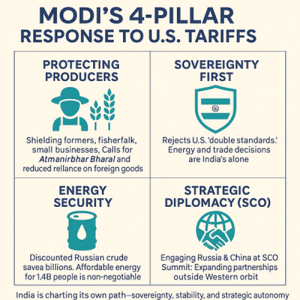


  1. Energy Security Above All

At the heart of this dispute is energy. By importing discounted Russian crude, India has saved an estimated $15–20 billionsince 2022. These savings are not a luxury—they have helped cushion the Indian economy from global oil shocks and kept domestic inflation under control. 

Modi’s government has repeatedly emphasized that affordable and reliable energy for 1.4 billion people is non-negotiable. Even as U.S. tariffs bite into export sectors such as textiles, gems, and IT services, India has not curtailed Russian oil imports. 

In Modi’s framing, energy security is not just an economic calculation—it is a sovereign responsibility. By ensuring stable supplies, the government protects households, industries, and overall economic growth. In that context, Washington’s demand that India stop importing Russian oil is viewed as unrealistic and intrusive. 


  1. Strategic Diplomacy: Turning to the SCO, Russia, and China

While defending India’s autonomy at home, Modi has also turned outward—deepening ties with alternative partners. His participation in the Shanghai Cooperation Organisation (SCO) Summit two weeks back was more than symbolic. By engaging directly with both Russia and China in that forum, Modi signaled that India has multiple avenues for cooperation beyond the Western orbit. 

At the summit, Modi held bilateral meetings with both President Vladimir Putin and President Xi Jinping, reinforcing India’s position as a country that can maintain dialogue with all major powers—even when they are at odds with each other. 

For Russia, these talks underscored the importance of India as a steady customer and strategic partner. For China, despite ongoing border tensions, the engagement demonstrated India’s willingness to keep channels open in pursuit of broader regional stability. 

By leaning into the SCO, Modi sent a clear message: if traditional Western partners tighten the screws, India has other options. This balancing act is not about abandoning the U.S., but about multiplying India’s leverage in a fragmented global order. 


Paying a Price—But Standing Firm 

Modi has openly acknowledged that resisting U.S. pressure may come at a cost. The new tariffs threaten to erase some of the financial benefits India reaped from cheap Russian oil. Export-oriented industries could face job losses, and trade tensions could weigh on broader U.S.-India relations. 

Yet Modi has framed this as a price worth paying. By portraying the dispute as a defense of sovereignty and a stand for India’s poor and middle classes, he has turned potential vulnerability into political strength. In effect, he is asking Indians to accept short-term pain for the sake of long-term independence. 


Conclusion: India’s Path in a Shifting Global Order 

The clash over Russian oil tariffs is about more than trade. It is a test of India’s place in the world—and Modi has seized the moment to reassert India’s sovereignty, protect domestic interests, and secure critical energy supplies. 

By strengthening partnerships through forums like the SCO and refusing to bow to external pressure, Modi is charting a course that blends pragmatism with principle. For global businesses, this signals that India will increasingly prioritize self-reliance and strategic autonomy—even if it means friction with major partners like the U.S. 

In a shifting global order, one thing is clear: India will chart its own path. 
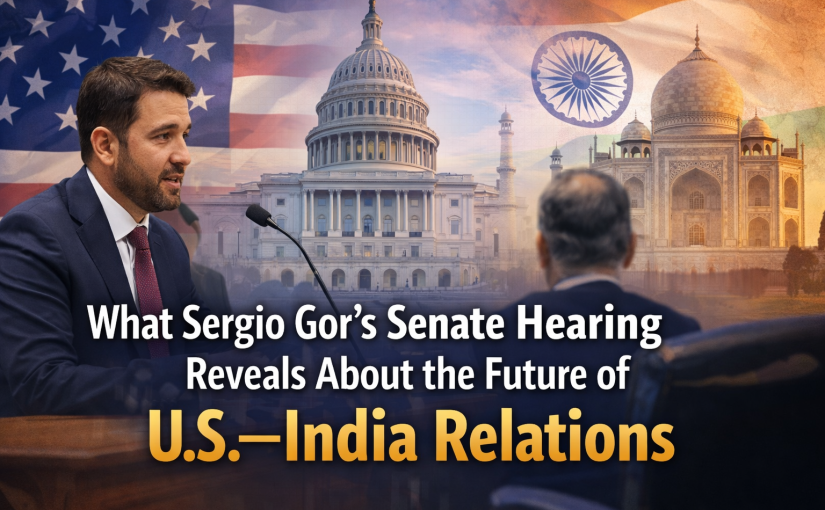
 

What Sergio Gor’s Senate Hearing Reveals About the Future of U.S.–India Relations

In Washington last week, Sergio Gor—the nominee for U.S. Ambassador to India—sat before the Senate for his confirmation hearing. On the surface, it was a routine step in filling a long-vacant post in New Delhi. But look closer, and the hearing became something more: a window into how America’s political spectrum now views India. What emerged was bipartisan recognition that India is central to the U.S. strategy in the Indo-Pacific, and a roadmap of issues that will define the next chapter of U.S.–India engagement. 

As business leaders and supply chain professionals, we should pay attention. The themes that surfaced—trade, energy, technology, defence, and strategic autonomy—are not abstract policy lines. They directly shape market access, investment opportunities, and global risk management. 

1. India at the Core of the Indo-Pacific

Secretary of State Marco Rubio set the tone bluntly: India is “at the core” of America’s Indo-Pacific strategy. The logic was practical—without a confirmed ambassador who can pick up the phone and get a direct line to the Oval Office, opportunities are missed, and risks multiply. For India, this means Washington wants decisions faster, outcomes clearer, and channels more senior. 

For companies navigating bilateral trade, this is encouraging. It suggests less time lost in bureaucratic gears and more emphasis on unblocking stalled negotiations. 

2. Trade and Market Access—From Friction to Framework

Trade dominated the conversation. Senators voiced concern about non-tariff barriers, regulatory delays, and restricted access for U.S. exports. Gor countered with “Mission 500”—a goal to double U.S.–India trade to $500 billion by 2030. 

How? By targeting quick wins: specific tariff reductions, smoother investment approvals, and pilot projects in sensitive sectors. The tone was not confrontational but calibrated—push firmly, but not so hard that India turns to alternative alignments with Russia or China. For businesses, this signals a structured approach to resolving irritants while keeping the bigger prize in view: a long-term convergence of the two economies.

3. Energy Security and the Russia Equation

India’s imports of Russian crude oil drew sharp questions. Senators explored punitive tariffs on secondary transactions, while Gor emphasized realism: unless the U.S. and allies can supply reliable alternatives at scale, India cannot simply walk away from Russian barrels. 

This is a pivotal message. Washington intends to expand LNG and crude exports to India, along with infrastructure support. For India, energy security remains paramount. For U.S. exporters and supply chain players, new opportunities may emerge in energy logistics, storage, and midstream infrastructure.

4. China, the Quad, and Regional Balance

The hearing repeatedly circled back to China. Republicans pressed for a faster, more robust Quad—joint exercises, interoperability, supply chain resilience. Democrats agreed on fundamentals but cautioned against overhyping optics at the expense of substance. 

For India, the signal is clear: Washington views defence and deterrence cooperation as steady and resilient, even when trade disagreements flare. For global supply chains, it underscores the Quad’s role not just in security but in setting standards for infrastructure, technology, and resilience.

5. Technology and Supply Chains: Out-Innovating Beijing

On technology, the Senate displayed rare bipartisan unity. The U.S. wants to fuse its innovation ecosystem with India’s scale and engineering depth. The focus: semiconductors, AI, quantum, and secure digital connectivity. 

But cooperation comes with conditions: trusted frameworks for IP, export controls, and standards for security and interoperability. For India, this is both an opportunity and a challenge. Done right, it could lock in a “trusted tech corridor” that drives research, pilot production, and manufacturing. For supply chains, it means India is being positioned as a partner of choice in diversifying away from China. 

6. Defence: From Big Statements to Everyday Interoperability

The conversation on defence was less about grand deals and more about practical to-do’s: expand joint exercises (especially in high-altitude environments), finalize defence sales, and move toward co-development and co-production. The ambition is clear—normalize everyday military familiarity so that coordination in a crisis is faster and adversary planning is harder. 

7. Strategic Autonomy and BRICS

Some senators worried about India’s role in BRICS, especially around de-dollarisation. Gor’s response was pragmatic: India often acts as a brake, not an accelerator, on those agendas. Washington respects India’s autonomy but is keen to make partnership with the U.S. the most rewarding option—in finance, technology, and defence production. 

This is crucial for business leaders to understand. India will not abandon its independent voice, but it increasingly seeks partnerships that deliver tangible economic and strategic value. 

Looking Ahead: What India Should Expect 

From the hearing, three parallel tracks stand out: 

  • Structured trade bargaining: targeted tariff fixes and sectoral pilots that build momentum. 
  • Energy rebalancing: credible U.S. offers in LNG, crude, and infrastructure to reduce Russian exposure. 
  • Tech and defence operationalisation: concrete progress on joint design, production, and trusted standards in emerging technologies. 

And underpinning all this is one method: speed. Washington expects Gor, if confirmed, to operate like a hotline—reducing noise, accelerating compromise, and ensuring India has fast, senior-level access. 

Final Thought 

The U.S.–India relationship is entering a test phase. Tariffs and Russia remain friction points, but bipartisan consensus in Washington sees India not as an optional partner but as indispensable to the Indo-Pacific. If trade talks gain traction, if energy substitution becomes credible, and if tech and defence cooperation deepen, the relationship could shift from tactical bargains to a strategic bond that reshapes global supply chains. 

For companies, investors, and policymakers, this is not just geopolitics. It’s a call to prepare for a future where U.S.–India convergence is one of the defining forces in global trade and security.